1. If you want to go camping, what’s things do you need?
a. tent
b. camping bag
c. mat
d. sleeping bag
e. raincoat
f. lighting equipment
g. flashlight
h. baterry
i. hat
j. gloves
k. socks
l. camping shoes
m. clothing
n. compass
o. stationery
p. knife
q. rope
r. stove
s. medicines
t. P3K
2.Make a conversation between receptionist and guess
Imagine that you are as a hotel receptionist.
Receptionist: Thank you for calling LG Visa, this is Kelly speaking,how may Ihelp you?
Customer: Hello, my name is Danni and I want to dispute a charge my statement.
Receptionist: Kelly Project Hotel, May I help you?
Customer: Yes, I like to book a room, please
Receptionist: Ok, miss. What is your name?
Customer: Stefani Hudson
Receptionist: Would you please spell your name, sir?
Customer: Ok ,it is Stefani Hudson
Receptionist: May I have your telephone number please?
Customer: it is 5566778
Receptionist: Well,5566778 right miss
Customer: Yes, that is right.
Receptionist: Anyway miss, we have single room and double room, which do you prefer?
Customer: Well, I do prefer a single room
Receptionist: How, long will you stay here, Miss?
Customer :I willl stay there about 5 days and I will check in on Saturday at 2 p.m in the afternoon.
Receptionist: Ok. Miss I will prepare your room
Customer: Thank you and see you then
Receptionist: See you
3.Mojokerto Regency has many potential tourism objects but it lack of promotions,now try to make a promotion about touristm object in Mojokerto
UBALAN SWIMMING POOL
Ubalan swimming pool is located in south of Mojokerto. It has strategic location. The wide of are about 1000 meters. There are three pool,one of pools especially for children in ubalan also many facilitaes. There are playground,outbond,café,etc. Theprice of ticket is cheap. Its about 6000 rupias and additional ticket for swimming about 5000.
Ubalan is one of beautiful tourism in Mojokerto. It has nice view,natural atmosphere,cheap and safety park area.
We can spend our holiday and weekend in ubalan. Its must be exciting.
So you must go to ubalan. Its very nice for your holiday
Minggu, 12 Desember 2010

Minggu, 05 Desember 2010
Job Interview
First Impressions
The first impression you make on the interviewer can decide the rest of the interview. It is important that you introduce yourself, shake hands, and be friendly and polite. The first question is often a "breaking the ice" (establish a rapport) type of question. Don't be surprised if the interviewer asks you something like:
- How are you today?
- Did you have any trouble finding us?
- Isn't this great weather we're having?
Interviewer: How are you today?
You: I'm fine, thank you. And you?
OR
Interviewer: Did you have any trouble finding us?
You: No, the office isn't too difficult to find.
OR Interviewer: Isn't this great weather we're having?
You: Yes, it's wonderful. I love this time of year.
Interviewer: Did you have any trouble finding us?
You: No, the office isn't too difficult to find.
Here are some examples of incorrect responses:
How are you today?
So, so. I'm rather nervous actually.
OR
Interviewer: Did you have any trouble finding us?
You: As a matter of fact it was very difficult. I missed the exit and had to return via the highway. I was afraid I was going to be late for the interview.
OR Interviewer: Isn't this great weather we're having?
You: Yes, it's wonderful. I can remember this time last year. Wasn't it awful! I thought it would never stop raining!
Interviewer: Did you have any trouble finding us?
You: No, the office isn't too difficult to find.
Getting Down to Business
Once the pleasant beginnings have finished, it's time to begin the real interview. Here are a number of the most common questions that are asked during the interview. There are two examples of excellent replies given for each question. Following the examples, you will find a comment describing the type of question and important things to remember when answering that type of question.
Interviewer: Tell me about yourself.
Candidate: I was born and raised in Milan, Italy. I attended the University of Milan and received my master's degree in Economics. I have worked for 12 years as a financial consultant in Milan for various companies including Rossi Consultants, Quasar Insurance and Sardi and Sons. I enjoy playing tennis in my free time and learning languages.
Candidate: I've just graduated from the University of Singapore with a degree in Computers. During the summers, I worked as a systems administrator for a small company to help pay for my education.
Comment: This question is meant as an introduction. Do not focus too specifically on any one area. The above question will often be used to help the interviewer choose what h/she would like to ask next. While it is important to give an overall impression of who you are, make sure to concentrate on work related experience. Work related experience should always be the central focus of any interview (work experience is more important than education in most English speaking countries).
Interviewer: What type of position are you looking for?
Candidate: I'm interested in an entry level (beginning) position.
Candidate: I'm looking for a position in which I can utilize my experience.
Candidate: I would like any position for which I qualify.
Comment:You should be willing to take an entry level position in an English speaking company as most of these companies expect non-nationals to begin with such a position. In the United States, most companies provide many opportunities for growth, so don't be afraid to start from the beginning!
Interviewer: Are you interested in a full-time or part-time position?
Candidate: I am more interested in a full-time position. However, I would also consider a part-time position.
Comment: Make sure to leave open as many possibilities as possible. Say you are willing to take any job, once the job has been offered you can always refuse if the job does not appeal (not interest) to you.
Interviewer: Can you tell me about your responsibilities at your last job?
Candidate: I advised customers on financial matters. After I consulted the customer, I completed a customer inquiry form and catalogued the information in our database. I then collaborated with colleagues to prepare the best possible package for the client. The clients were then presented with a summarized report on their financial activities that I formulated on a quarterly basis.
Comment: Notice the amount of detail necessary when you are talking about your experience. One of the most common mistakes made by foreigners when discussing their former employment is to speak too generally. The employer wants to know exactly what you did and how you did it; the more detail you can give the more the interviewer knows that you understand the type of work. Remember to vary your vocabulary when talking about your responsibilities. Also, do not begin every sentence with "I". Use the passive voice, or an introductory clause to help you add variety to your presentation
Interviewer: What is your greatest strength?
Candidate: I work well under pressure. When there is a deadline (a time by which the work must be finished), I can focus on the task at hand (current project) and structure my work schedule well. I remember one week when I had to get 6 new customer reports out by Friday at 5. I finished all the reports ahead of time without having to work overtime.
Candidate: I am an excellent communicator. People trust me and come to me for advice. One afternoon, my colleague was involved with a troublesome (difficult) customer who felt he was not being served well. I made the customer a cup of coffee and invited both my colleague and the client to my desk where we solved the problem together.
Candidate: I am a trouble shooter. When there was a problem at my last job, the manager would always ask me to solve it. Last summer, the LAN server at work crashed. The manager was desperate and called me in (requested my help) to get the LAN back online. After taking a look at the daily backup, I detected the problem and the LAN was up and running (working) within the hour.
Comment: This is not the time to be modest! Be confident and always give examples. Examples show that you are not only repeating words you have learned, but actually do possess that strength.
Interviewer: What is your greatest weakness?
Candidate: I am overzealous (work too hard) and become nervous when my co-workers are not pulling their weight (doing their job). However, I am aware of this problem, and before I say anything to anyone, I ask myself why the colleague is having difficulties.
Candidate: I tend to spend too much time making sure the customer is satisfied. However, I began setting time-limits for myself If I noticed this happening.
Comment: This is a difficult question. You need to mention a weakness that is actually a strength. Make sure that you always mention how you try to improve the weakness.
Interviewer:Why do you want to work for Smith and Sons?
Candidate: After following your firms progress for the last 3 years, I am convinced that Smith and Sons are becoming one of the market leaders and I would like to be part of the team.
Candidate: I am impressed by the quality of your products. I am sure that I would be a convincing salesman because I truly believe that the Atomizer is the best product on the market today.
Comment: Prepare yourself for this question by becoming informed about the company. The more detail you can give, the better you show the interviewer that you understand the company.
Interviewer: When can you begin?
Candidate: Immediately.
Candidate: As soon as you would like me to begin.
Comment: Show your willingness to work!
The above questions represent some of the most basic questions asked on any job interview in English. Probably the most important aspect of interviewing in English is giving detail. As a speaker of English as a second language, you might be shy about saying complicated things. However, this is absolutely necessary as the employer is looking for an employee who knows his or her job. If you provide detail, the interviewer will know that you feel comfortable in that job. Don't worry about making mistakes in English. It is much better to make simple grammar mistakes and provide detailed information about your experience than to say grammatically perfect sentences without any real content.
Job Vacancy
Job Vacancy as Web Programmer - PT Adira Dinamika Multi Finance TbkPT Adira Dinamika Multi Finance Tbk (ADMF), a leading multifinance company, with more than 150 branches and rep. offices, has an open vacancy for Web Programmer
Web Programmer
Wth the following qualifications:
* S1 Degree in Information Systems, Computer Science or other related major with minimum GPA 2.75.
* Good interpersonal and communication skills, self motivated, hardworking, willing to learn, excellent team player, and able to work independently.
* Prior working knowledge on web application development would be great advantages
* Fresh graduates are welcomed to apply!
To apply, please send your cover letter, resume and recent photograph to:
Aqomy Fauzan Fanany
IT Enterprise Application Department
PT Adira Dinamika Multi Finance Tbk.
Jl. Agus Salim No. 63
Jakarta Pusat 10340
Or
e-mail to aqomy.fauzan@adira.co.id (Please, do not exceed 200KB of mail size limit)
Only shortlisted candidates will be notified.
Posted Date : Monday 07th of January 2008 06:13 PM
Web Programmer
Wth the following qualifications:
* S1 Degree in Information Systems, Computer Science or other related major with minimum GPA 2.75.
* Good interpersonal and communication skills, self motivated, hardworking, willing to learn, excellent team player, and able to work independently.
* Prior working knowledge on web application development would be great advantages
* Fresh graduates are welcomed to apply!
To apply, please send your cover letter, resume and recent photograph to:
Aqomy Fauzan Fanany
IT Enterprise Application Department
PT Adira Dinamika Multi Finance Tbk.
Jl. Agus Salim No. 63
Jakarta Pusat 10340
Or
e-mail to aqomy.fauzan@adira.co.id (Please, do not exceed 200KB of mail size limit)
Only shortlisted candidates will be notified.
Monday 07th of January 2008 06:13 PM
Minggu, 29 Agustus 2010
It's about Mojokerto
The Symbol of Mojokerto Regency
The Symbol of Mojokerto Regency has specified based on PERDA Mojokerto Municipality number 3 in 26 Aprils 1971 by DPRGR Mojokerto municipality.
The Form of Symbol
1. Leaf Symbol is form of angular shield 5 (five).
2. Green symbol with yellow peripheral has painted paddy and cotton.
3. In the middle of leaf symbol is describes:
Tree MAJA picture have its rooting is 12, its fruit is 9 and its surging blue line branch is 3.
4. Under the leaf symbol, there is a band picture write down “Mojokerto City"
The Meaning of Form and Color Symbol
1. Shield is the defense
2. The 5 angle is depicting the Unity States Philosophy of Republic Of Indonesia PANCASILA
3. Green symbol with yellow peripheral has painted paddy and cotton symbolize of prosperity.
4. Blue line symbolize the Brantas river that flow in the side of town and as one of prosperity infrastructure.
5. Green color is symbolize the prosperity
6. Tree MAJA picture have its rooting is 12, its fruit is 9 and its 3 branch mean 1293 reminding to forming of Majapahit Kingdom.
The History of Mojokerto Regency
The history of the Government of Mojokerto regency has strong related with the history of Mojopahit Kingdom, which during the feather had led by a king named Hayam Wuruk in 1350 - 1389 with his great Prime Ministry Gajah Mada.
Mojopahit Kingdom is a big state, located in Brantas River, Delta area and Brangkal River, and has a strong defense that is enough Taft in facing the colonial team. At that time, Canggu area as the port area is the gateway of all activities of commerce traffic (logistics). For the fluency of communications and transportation, Mojopahit made road to connect the port area of Canggu with center capital. Mojokerto regency as the center goverment of Mojopahit, now, it still leaves many evidences, for example the naming of Prajurit Kulon, Magersari, Suronatan, Sentanan, etc.
Year to year, hence the history of Mojopahit has under the Netherlands colonization. At the Dutch Government, Mojokerto regency formed as Stage menthe based a governor J. Van Limburgstirum decision on 20 Junes 1918, Staatblad in 1918 Numbers 324. Then at Japan epoch, Mojokerto regency was having status, as ‘sidi’. Sie Cok and Sie Sangikat who had its proxy beside proxy from Mojokerto area held the Government.
In 1945, Mojokerto regency is East Java front line defense, where the Division Headquarter I had led by the commander of Sungkono division. At that moment, their teams were face to Colonials team and had backward reached Mojokerto. As struggle bases area, Mojokerto regency along with the whole society, have shown the spirit of their struggle to faced the colonial attacked which would return the colonization government in Indonesia.
In memorize the heroism and patriotism spirit at our country, and to commemorate the warrior day in 10 Novembers, then it had carried out a traditional hiking of Mojokerto - Surabaya. Beside that, to memorize the spirit of the struggle, it had built a monument of proclamation that stands in the centre of Mojokerto great waves in which has changed for government building. Mojokerto regency with intensive effort from the Mojokerto regency Government has become LVRI building / 1945 Struggle Building.
In 1945 - 1950, the Mojokerto regency Government has executes the government become the part of Mojokerto regency government and governed by a proxy mayor beside the area national committee. At that time, the Mojokerto Regent has double duty to become a mayor and the member of Indonesia national committee.
In 1950, East Java country had became the part of indonesia, hence based on invitors Nomor 17 The year 1950, about Pembentukan the small area in East Java / Central Java / West Java province then confirmed as Township based on the law number 1 of 1957.
The law number 18 of 1965 its nomenclatures had turn into Mojokerto municipality then based on the law number 5 of 1974 was change again become area municipality level II Mojokerto, as part of expansion region of Gerbangkertosusila.
Since release of PP number 47 of 1982 about the Boundary Modification of Area Municipality Region Level of II Mojokerto, region wide of Mojokerto municipality become 16, 46 KM2, which consist of two district regions, that is Magersari district and Prajurit Kulon with 18 Countryside / Sub-district.
Then with the existence of the law number 22 of 1999, about area government, Area Municipality Level II MOJOKERTO like other areas changed nomenclature to become the Government of Town Mojokerto.
The forming of The Government of Mojokerto city through a history process being had started with status as Staadgemeente, and based on result of research, area municipality level II Mojokerto number HK. 66 of 1982 specify that the anniversary of Mojokerto regency be on 20 Junes.
Geographically
Town Region Mojokerto reside in 7°33 ' LS and 122°28 ' BT with regional boundaries as follows:
North side: Brantas River
Eastside: Puri District Mojokerto regency
Side South: Sooko and Puri District Mojokerto regency
Westside: Sooko District Mojokerto regency
Topographically
Mojokerto Region regency lay in height about 22 meters from sea level and inclination of soil 0% - 3%. Thereby can be showed that Mojokerto city have to surface of soil that is relatively flat, so that the river flow channel become relative slowness and this thing has quicken the superficiality that finally arise the pond at various part of towns in the rain.
Soil type
The soil type in Mojokerto regency consisted of alluvial ( 6274%) and grumosol ( 3726%). From the condition soil type in Mojokerto regency is good enough soil to effort for agriculture, because the soil consisted of sediment of mixed clay with smooth sand, cushy with retainer energy of good enough water and containing of enough mineral for flora.
Soil Ability
The soil in Mojokerto regency has backing by:
Depth of soil effectiveness cover overall of Mojokerto city namely depth of 90 cm and more. That region show good region, which has good soil for growth of crop root.
Soil texture as a whole has fine texture class / ductile had determined by the comparison of sand faction, dirt and clay.
Tough drainage showing stripper and frequently saturated soil to water content and speed diffuse it water from surface of soil, reach 1575,44 Ha ( 95,68 % ) have never suffused and 71,095 Ha ( 4,317 % ) suffused periodical.
Almost never has erosion of Mojokerto regency because its soil type is alluvial and grumosol.
Hydrology
Mojokerto regency is DAS Brantas area along the length of 3,50 km, DAS BRANGKAL river along the length of 2,25 km and Sadar river along the length of 2 kms, which its benefit is useful for resident life, especially for irrigation of agriculture.
Climate
Climate in Mojokerto regency has distinguished with the existence of the rains and dry season with rainfall average of 10, 58 mm. The rainfall influence both direct and indirect is cropping pattern namely usage intensity of soil and available of irrigation water. While, temperature reach 220 - 310 with dampness of air 74,3 - 84,8 Mb / day and wind velocity average of shifting 3,88 - 6,88 knots / month.
Description of Land Use
Usage aspect of soil / farm in Mojokerto can depict the domination of usage between areas woke up and it have not woke up and its spreading in 1999 usages of soil / farm in Mojokerto earn which describe as follows (based on Mojokerto regency broadly 16,46 km2):
Settlement = 44,14 %
Education = 0,79 %
Industry = 4,34 %
Agriculture = 41,76 %
Effort For Commerce = 2,76 %
White collars = 2,46 %
Health = 0,66 %
Supporting Facilities For Communication= 2,40 %
Grave / mausoleum = 0,04 %
Field events = 0,15 %
Observance = 0,21 %
Others = 0,24 %
(Data source : BPN Town Mojokerto)
Bajak sauce
8 red chilies seeded and sliced
1 tsp dried shrimp paste (terasi) toasted
1/4 tsp grated nutmeg
3 garlic cloves peeled and sliced
6 shallots peeled and sliced
1 tsp salt
1 1/2 tsp chopped palm sugar
2 tbl oil
2 salam leaves
2 lemongrass stalks bruised
1/2 inch galangal (laos) peeled and sliced
4 tbl tamarind juice
Grind with a mortar and pestle or blend the first 7 ingredients very finely.
Heat the oil over medium-high heat. Saute the ground ingredients along with salam leaves, lemongrass and galangal. Stir it frequently until the mixture changes color and becomes very fragrant.
Pour the tamarind juice and let it simmer for about a minute and then leave to cool.
Remove salam leaves, lemongrass and galangal before serving.
Keeps up to 1 week or longer if refrigerated.
1 tsp dried shrimp paste (terasi) toasted
1/4 tsp grated nutmeg
3 garlic cloves peeled and sliced
6 shallots peeled and sliced
1 tsp salt
1 1/2 tsp chopped palm sugar
2 tbl oil
2 salam leaves
2 lemongrass stalks bruised
1/2 inch galangal (laos) peeled and sliced
4 tbl tamarind juice
Grind with a mortar and pestle or blend the first 7 ingredients very finely.
Heat the oil over medium-high heat. Saute the ground ingredients along with salam leaves, lemongrass and galangal. Stir it frequently until the mixture changes color and becomes very fragrant.
Pour the tamarind juice and let it simmer for about a minute and then leave to cool.
Remove salam leaves, lemongrass and galangal before serving.
Keeps up to 1 week or longer if refrigerated.
Permainan Benteng-bentengan
Bentengan, is a game played by two groups, respectively - each consisting of 4sampai with eight people. Each - each group to choose a place as a headquarters, usually a pillar, or pillars of stone as a 'fortress'.
1. Game
The main objective of this game is to attack and take over the 'stronghold' opponent by touching the pole or pillar that has been chosen by the opponent and shouting
fort. The victory also could be achieved with a captivating 'all members of the opponent by touching their bodies. For anyone who has the right enentukan to 'trap' and the captives' determined from the last time when the 'trap' or 'captive' touched 'fortress' of their own - each.
2. Prisoner
The person closest to the time when touching the fort is entitled to captor 'and can catch up and touch the members of the opponent to make them prisoners. Prisoner usually placed around the enemy lightly. Prisoner also be exempt if his partner could touch her.
3. Tactics
In this game, usually each - each member has a duty such as' invaders', 'eyes - the eyes,' bullies', and keep the 'fortress'. This game really need the speed to run and also the ability of a reliable strategy.
1. Game
The main objective of this game is to attack and take over the 'stronghold' opponent by touching the pole or pillar that has been chosen by the opponent and shouting
fort. The victory also could be achieved with a captivating 'all members of the opponent by touching their bodies. For anyone who has the right enentukan to 'trap' and the captives' determined from the last time when the 'trap' or 'captive' touched 'fortress' of their own - each.
2. Prisoner
The person closest to the time when touching the fort is entitled to captor 'and can catch up and touch the members of the opponent to make them prisoners. Prisoner usually placed around the enemy lightly. Prisoner also be exempt if his partner could touch her.
3. Tactics
In this game, usually each - each member has a duty such as' invaders', 'eyes - the eyes,' bullies', and keep the 'fortress'. This game really need the speed to run and also the ability of a reliable strategy.
apem cake
Ingredient :
150 gram tape cassava
150 grams of brown sugar, if you want brown
100 grams of sugar, if you want white
150 cc of coconut water
250 grams of rice flour
* 100 cc coconut milk
125 cc water
Coconut:
100 grams shredded coconut
1 / 4 teaspoon salt
Syrup:
100 grams of brown sugar
50 cc water
1 / 4 teaspoon salt
1 pandan leaves
150 grams of brown sugar, if you want brown
100 grams of sugar, if you want white
150 cc of coconut water
250 grams of rice flour
* 100 cc coconut milk
125 cc water
Coconut:
100 grams shredded coconut
1 / 4 teaspoon salt
Syrup:
100 grams of brown sugar
50 cc water
1 / 4 teaspoon salt
1 pandan leaves
Method:Coconut: Mix all ingredients, stir well, then steam for 10 minutes, remove, set aside.
Syrup: Mix all ingredients, stir well, cook until thickened, lift, then strain and set aside.
Apem: mix tape cassava and sugar or sugar, mix well and fine, and enter the coconut milk and water, stirring until dissolved and smooth, strain.
1. Pour the rice flour with water mix tape was a little while continuing diuleni until smooth about 10 minutes, then leave in a warm place for 12 hours or overnight to rise and bubble.2. Enter a little coconut milk, stirring constantly until flat, then pour into baking dish that has been smeared with a little oil, steam for 45 minutes until cooked, remove, cool, cut into pieces.3. Apem Serve cake with coconut or syrup.
Syrup: Mix all ingredients, stir well, cook until thickened, lift, then strain and set aside.
Apem: mix tape cassava and sugar or sugar, mix well and fine, and enter the coconut milk and water, stirring until dissolved and smooth, strain.
1. Pour the rice flour with water mix tape was a little while continuing diuleni until smooth about 10 minutes, then leave in a warm place for 12 hours or overnight to rise and bubble.2. Enter a little coconut milk, stirring constantly until flat, then pour into baking dish that has been smeared with a little oil, steam for 45 minutes until cooked, remove, cool, cut into pieces.3. Apem Serve cake with coconut or syrup.
Senin, 02 Agustus 2010
About Mojokerto
Mojokerto is one of the districts in East Java Province, Indonesia.[1] It is located 40 km southwest of Surabaya, and constitutes one of the regional units of Gerbangkertosusila Development (a linkage of towns and city connecting Gresik, Bangkalan, Mojokerto, Surabaya, Sidoarjo, and Lamongan, supposed to sustain Surabaya as center of business and industrial activities).
Geographic area
- Northern boundary: Gresik and Lamongan
- Southern boundary: Malang
- Eastern boundary: Sidoarjo and Pasuruan
- Western boundary: Jombang
Mojokerto’s territory is 872 km², located between 15 m and 3,156 m above sea level. It is divided into north and south regions by the Brantas River. South Region has several mountains, which includes Welirang Mountain (3,156 m), Anjasmoro Mountain (2,277 m) and Penanggungan Mountain (1693m).
One of the several beautiful locations in Mojokerto is Pacet, it has a magnificent mountainous view
Mojokerto is divided into Kotamadya Mojokerto and Kabupaten Mojokerto, Kotamadya Mojokerto consists of two kecamatans: Kecamatan Prajurit Kulon and Kecamatan Magersari
Mojokerto is big 5 industry town in east java. Central industry located in Mlirip,Ngoro,Jetis.
Mojokerto is divided by 12 subdistricts:
1.Jatirejo 2.Gondang 3.Pacet 4.Trawas 5.Ngoro 6.Pungging 7.Kutorejo 8.Mojosari 9.Bangsal 10.Mojoanyar 11.Dlanggu 12.Puri 13.Trowulan 14.Sooko 15.Gedeg 16.Kemlagi 17.Jetis 18.Dawar Blandong
Demographics and overview
The population of the district is about 881,000 (2000). Many of them earn their living as small farmers and craftsmen (consisting shoemakers, furniture makers, and souvenir makers).
Mojokerto occupies a strategic position and role in East Java. It functions as a reliable sustaining stock of foodstuff and tourist attraction. PPLH (Pusat Pendidikan Lingkungan Hidup – Seloliman Environmental Education Centre) is located in Mojokerto, it is a non-governmental organization aiming to further raise environmental awareness. Historically, Mojokerto is widely known as the then center of Wetan Mas Kingdom of King Airlangga (1029/1041), and of Majapahit Kingdom with its Brawijaya dynasty (1292-1400) and its territories exceeding Nusantara (standardized concept of Indonesian archipelagic territories).
Mojokerto has a motto of "Kota Budi Parinda"
The Seven Age Anniversary Plan of Majapahit Glory
Since four years ago, there have been several cultural fairs in East Java, lasting for a week. Some 37 districts participated. These activities have been held in alternate towns and cities such as Surabaya, Malang, Jember, Madiun. The activities were aimed at utilizing East Java’s specific potentials either in the form of traditional arts or special foods in the framework of marketing tourist objects of East Java. This year coinciding with the year of the Green Environment, of Tourist Visit, and of Seven-Age commemoration stipulated Mojokerto as the site for holding cultural fair. For this purpose local and provincial committee are and have been taking the following measures:
- To hold a symposium on the verge of seven-age anniversary of Majapahit and to carry any book-writing concerning Majapahit
- To designate the year of Green Environment by planting rare plants in the area Majapahit remains; thirty seven Kabupaten in East Java Province will participate on this occasion.
- To innovate Majapahit’s artifacts (archaeological remains)
- To establish facilities of tourists objects
Various activities being arranged are as follows:
- East Java’s cultural and tourist fair reflecting the glory of Majapahit
- Archaeological Exhibition
- Seminars of archaeologists and historians
- Cultural arts and festivals
- Introduction to tourist objects
The above mentioned events took place from July 5, 1993 to July 15, 1993. Some foreign tourists came from China, Finland, Denmark, Malaysia and the Middle East.
Kebaya, Mojokerto's traditional dress

There is much speculation as to where the kebaya could have originated from. There are some who say that the kebaya originated in the Middle East, while others argue that it may have come from nearby China. Derived from the Arabic word kaba meaning “clothing” and introduced to Indonesia via the Portuguese language, the term kebaya has come to refer to a garment whose origins appear to be a blouse. It was first worn in Indonesia at some time during the 15th and 16th centuries. This garment is similar to what is described as a “long, fitted, flared kebaya known as kebaya panjang6, worn in the 16th century by Portuguese women arriving on the south-western coast of Malaysia, situated across the Malacca Straits from Sumatra, in northwestern Indonesia.
Many sources also cite Chinese influences on clothing of the time, one source comparing the kebaya to an open-fronted long-sleeved tunic worn by women of the Ming Dynasty. The introduction of this kind of dress were accredited to two major occurrences of this time; the emerging influence of Islam and the arrival of the Europeans to the archipelago. Whether it was Arabia or China that brought us the wonderful kebaya, there is no denying how quick the use of this garment was made uniquely Indonesian and spread from one island and ethnic group to another which its own regional variations. This quick diffusion of the use of the kebaya was also linked to the spice trade that was happening during this time in history.
Origins of the Kebaya
After Dutch colonization, the kebaya took on a new role as the formal dress for the European women in the country. During this time, the kebaya was made mostly from mori fabric. Modifications made to this traditional costume later introduced the use of silk and embroidery to add design and color. The most dominant form of kebaya worn on the islands of Java and Bali today, can be visibly traced to the kebaya worn in Java and Sunda from the late 19th - early 20th century onwards.
Many of the easily recognizable features of today’s kebaya – a tight fitting blouse that enhances the torso of the woman; the fold-back collarless neck and front opening; long sleeves; and the type of semi-transparent fabric – are evident in the kebaya of the past century. Traditional kebaya required the torso of the women to be wrapped with a long piece of cloth called a stagen. Women of higher social status would have help in wrapping their torso with the stagen however women who were not so fortunate to have help could dress themselves by tying the end of the stagen to a post and literally wrapping themselves into it.
The semi-transparent kebaya blouse was then worn overtop of the stagen. This blouse was fastened with a brooch rather than buttons and buttonholes. It was customary to combine the kebaya with kain – a length of unstitched cloth worn on the lower part of the body, often (and incorrectly) referred to in the English language as sarong. This kain was wrapped around the body with the pleats being placed at the front of the body. Traditinally this kain was dipped in a cornstach solution and then carefully folded by hand into pleats and pressed to produced the crisp look that was desired.

Indigenous Dress in the Making of a Nation
Considering the enormous historical – political and social – shifts that have occurred in Indonesia during the last century, the form of the kebaya, has remained relatively unchanged. Its function and meaning however, in contrast to its form, has seen major changes in colonial and post-colonial Indonesia, operating to meet different groups’ political agendas, social needs and aspirations. The kebaya has come to symbolize the emancipation of women in Indonesia through a representation linking the kebaya to the 19th century “proto-feminist” figure of Raden A. Kartini.
During the 19th century, and prior to the Nationalist movement of the early 20th century, the kebaya had enjoyed a period of being worn by Indonesian, Eurasian, and European women alike, with slight style variations. During this time distinguishing class and status was important and produced variants of the basic costume. The kebaya of Javanese royalty were constructed of silk, velvet and brocade; Javanese women belonging to the commoner class wore figured cottons; the kebaya worn by Eurasian women was of white cotton trimmed with handmade European lace during the day, and of black silk in the evening; while the Dutch women preferred a shorter white kebaya. It was even possible for Dutch women planning to travel to the Dutch East Indies to purchase their kebaya in the Netherlands prior to leaving.
Emerging as National Dress
By the 1920s however, and with the full emergence of the nationalist struggle in Indonesia, European women stopped wearing the kebaya because it was identified with typical Indonesian attire. For the European colonizers the Kebaya had become associated with Indonesian nationalism.
During the period of the Japanese occupation of Indonesia (1942-1945), educated Indonesian women prisoners-of-war chose to wear kain-kebaya rather than the western dress allocated to them as prison dress. A different set of political conditions produced a reversal of meaning. In this situation the women employed a cultural code (of traditional dress) to assert their political position, differentiating themselves from their European women that were also prisoners-of-war.
During the Proclamation of Independence by President Sukarno on August 17, 1945, the only woman in attendance, Ibu Trimutri was wearing kain kebaya. This image helped transform the kebaya from mere traditional dress, elevating it to the status of national dress for Indonesia women.
From the Palace to the Street - Popular and Traditional Images
While the kebaya is worn by a wide range of women from the former President Megawati to the jamu street vendor, the kebaya could never be claimed to operate as a social leveller. Women who sell jamu (traditional herbal medicine), from young to old, and right across the islands of Java and Bali are wearing kebaya. Today, in Indonesia the image of a woman wearing kebaya sells a variety of products from traditional herbs to Betadine to fried chicken. As an icon the women in her traditional clothing - kebaya - sells tradition and all the purity and goodness belonging to Indonesian cultural traditions. Perhaps she also evokes an element of nostalgia for urban consumers. Traditional as a way of life, is often less about the differences between rural and urban settings, than about socio-economic and class distinctions. For women 50 years and older, whose occupations and way of life come to distinguish them as traditional, traditional clothing of kain-kebaya is their choice of daily dress. These women, the majority of whom belong to the lower socio-economic group, often work in traditional settings such as markets, are employed as house servants or work in the agricultural sector.
Today’s Kebaya
If we try to define what a kebaya is, it may prove to be difficult as it is constantly changing to reflect the changing times and fashions that Indonesia is experiencing. Nonetheless, it is possible to make some generalizations about the kebaya. Most Kebaya are made from a lace brocade. Most kebaya fabric uses a floral motif either printed or woven into the textile and its length can fall somewhere from above the waist to below the knee. It usually, but not always, has long sleeves. It is usually fastened at the front, and if not, then gives a semblance of doing so. Some variations of the kebaya will use a batik sash, which is coordinated with the kain, draped over the shoulder as an added accessory.
Although women in the market can be seen wearing kebaya, we can also see exquisite variations of them in government gatherings and parties and high society social functions. The beauty of this national dress is undeniable. Some of the most influential women in Indonesia are married in kebaya that can be described as “works of art” with their hand embroidered detailing and beading. Designers such as Ami Amianto have helped to promote the kebaya not only as a important part of Indonesian clothing history but as a very beautiful item of clothing that Indonesian women are proud to wear.
So the next time you see a women wearing a kebaya you will understand that she is not just wearing a functional piece of clothing but she is also wearing a symbol of Indoneia’s cultural history which represents national symbolism and high fashion too!

Gamelan
Gamelan
Almost every where in Yogya, Solo, Semarang and other cities in Central Java, in Karatons, in the market, in the villages, in the hotel's lobby, you should hear the magical melodious percussion music - the gamelan Javanese orchestra.
In his book 'music of Java' Jaap Kunst says, "Gamelan is comparable to only two things, moonlight and flowing water. ...mysterious like moonlight and always changing like flowing water ...".
Gamelan music is an integral part of all cultural activities in Java such as wayang kulit (leather puppets) performance, court dance, uyon-uyon (symphony orchestra performance), etc. There are two kinds of laras (tuning) in gamelan, namely slendro (comparable to minor key in Western music) and Pelog (major key). A complete set of gamelan consist of two sets of different instruments of Slendro and Pelog, such as:
- Kendang (double ended drum beaten by hands)
It is a leading instrument. The pengendang (drumer) is the conductor of the gamelan orchestra. There are five (5) different sizes of kendang from 20 cm to 45 cm. - Saron
A glockenspiel with bronze bar struck with wooden mallet. There are three kinds; Saron Barung, Saron Peking, Saron Demung.
- Bonang Barung
A double row of bronze kettles resting on a horizontal frame, played with two long stick bound with red cord at the striking end. - Bonang Penerus

- Slentem
Thin bronze bars suspended over bamboo resonating chambers, struck with a padded disc on the end of a stick. - Gender
Similar to slentem with more bronze keys and smaller bamboo chamber, struck with two disc-shaped hammers.
- Gambang
Wooden bars laid over a wooden frame struck with two sticks of supple buffalo horn, ending with a small, round, padded disc. - Gong
Each slendro and pelog set had three gongs. Two big gongs (Gong Ageng) and one gong Suwukan about 90 cm, made from bronze, suspended on a wooden frame. It marks the end of the largest phrase of the melody.
- Kempul
Smaller gongs, marks a smaller phrase. In each slendro and pelog set, there are 6 (six) or 10 (ten) kempuls. - Kenong
Smaller gongs lay horizontally on crossed cord, inside a wooden frame. A complete set of kenong in each slendro and pelog consist of 10 (ten) kenongs.
- Ketug
The kenong player also plays it smaller kenong, marks subdivisions of phrases. - Clempung
A string instrument, each slendro and pelog set needs one clempung. - Siter
Smaller cemplung, each slendro and pelog set needs one siter
- Suling
It is a flute, each slendro and pelog set, needs one suling. - Rebab
A two stringed viol, the same as slendro and pelog. - Keprak and Kepyak
Needed for gamelan to accompany dances. - Bedug
It is a very big drum.
In a gamelan music concert or karawitan performance, the Kendang player or pengendang conducts the Tempo, while the melody is led by the bonang player
The gamelan orchestra includes some singers (Pesinden), female as well as male. There are some very famous Pesindens, their names are almost known by everybody in this region.
Some believe that in the ancient time, the first set of gamelan, by the name of Lokananta was created by gods and played in Mount Lawu, Eastward of Solo.
In short the history of gamelan was as follow:
The first gamelan was the three-toned Munggang, then the five-toned slendro gamelan and the last: the seven-toned pelog gamelan.
Patet
In the laras slendro, there are:
- Slendro patet nem
- Slendro patet sanga
- Slendro patet manyura
- Pelog patet lima
- Pelog patet nem
- Pelog patet barong
Patet is a place to lay the gending or to establish the gending. In the wayang kulit (shadow puppet) whole night show, the gamelan plays,
Slendro patet nem from 9.00-12.00 p.m.
Slendro patet sanga from 00.00-03.00 a.m.
Slendro patet manyura from 03.00-06.00 a.m.
For an experienced gamelan player it should not difficult to determine the patet of a particular gamelan music. Or it can be said that patet is used to create mood, with the gamelan accompaniment. It is already known that various gamelan tunes are played to create different atmosphere of the situation or feeling such as joy, sorrow, anger etc.
Minggu, 01 Agustus 2010
Dhalang (puppeteer)

The dalang (Javanese: dhalang) is the puppeteer in an Indonesian wayang performance.
In a performance of wayang kulit, the dalang sits behind a screen (kelir) made of white cotton stretched on a wooden frame. Above his head, hanging from beams attached to the top of the screen, is the lamp (blencong), which projects the shadows onto the screen. In front of the dalang is a stage (debog), traditionally made from the trunk of a banana tree, into which the sharpened control rods of the puppets can be pushed to keep them in position during the performance. To his left is the puppet chest (kotak), and to his right is the puppet chest's lid, on which the puppets sit ready for use.
In addition to moving the puppets and speaking their lines, the dalang is also responsible for giving cues to the gamelan. This is done principally by playing the kepyak, a metal plate or set of plates played with his foot, or by rapping on the puppet chest (kotak) with a wooden mallet held in the left hand.
The art of puppetry (pedhalangan) was traditionally handed down within families, and dalangs formed a type of informal caste within Javanese society. The women of these families traditionally were expert players of the gendér, an instrument which has a particularly important role in accompanying wayang performances. The sons of dalangs were often apprenticed out around the age of 13 to another dalang. His role included helping to set up the screen ahead of a performance, performing the afternoon show before a main all-night wayang, and sometimes acting as an accompanying musician or as an assistant puppeteer. He would also frequently end up marrying his master's daughter, who would have been trained as a gendér player by her mother. The social aspects of the dalang caste are covered by Victoria Clara van Groenendael's book "The dalang behind the wayang" (Dordrecht, 1985)
Much of the traditional training of dalangs was in the form of a practical apprenticeship, with a certain amount of spiritual training thrown in. This included meditation and a form of ascetic exercise known as kungkum, in which meditation is carried out naked at night while immersed up to the neck in water. Such practices are felt to be essential in building up the stamina to perform for nine hours at a stretch. A further ascetic element is that dalangs never eat during the performance, although almost all drink sweet tea and many also smoke heavily.
In recent times, however, schools teaching pedhalangan have been founded, such as the Habirandha school within the Kraton Yogyakarta, which teach a standardized version of pedhalangan. The Habirandha school published its own textbook, the Pedhalangan Ngayogyakarta, in 1976. Standardized pedhalangan is also taught at Indonesian state institutions such as the Indonesian Institute of the Arts, Yogyakarta.
Pedhalangan falls into three main areas - musical, vocal and puppetry. The musical aspects include the direction and cueing of the gamelan and the singing of mood-setting songs (sulukan), the vocal includes the recitation of set texts at scene-openings (kandha) and the extemporisation of dialogue showing mastery of Javanese linguistic etiquette, while the puppetry itself (sabetan) involves a complex system of movements and positions. There is an extensive study of sabetan in English by Roger Long (see further Reading)


Congklak, Traditional Game of Mojokerto

One of the most fascinating things about living in Indonesia is the discovery of bits of Indonesian culture which are actually not Indonesian at all, but originate in other lands. For
 centuries, the Indonesian archipelago has been visited by traders from many corners of the world who came to buy spices and other agricultural riches. Indonesian cultural diversity benefited by the many peoples who passed through the archipelago, due to Indonesia's location along the primary trade route between Europe and Asia.
 Together with the items they brought to sell, these traders brought bits of their culture along with them as well. These included religion, language, foods and textile traditions. Less written about than spices, silks and ceramics, however, are the games brought to Indonesia by travelers over the centuries.
I've long been fascinated with Congklak, which I had thought of as a traditional Indonesian game since I first played it in Yogyakarta in the late 70s. Much to my surprise, my previously held belief in the Indonesian origins of this game was shattered when I saw a Congklak board in a cultural display organized by the African Women's Group in Jakarta some years ago. Upon seeing the game I said, “Oh, you play Congklak too ...” The women staffing the exhibit said “No, this is Wari, a traditional African game.” Thus, my first inkling of the widespread nature of this game.
Origins of Congklak
Congklak has its origins in either Africa or the Arab world, depending on which scholar's theory you choose to believe. Some of the oldest evidence was found in National 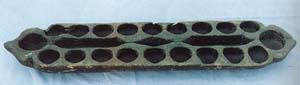 Geographic-sponsored archaeological diggings dating back to 7,000 to 5,000 BC in present-day Jordan. Excavations of a house uncovered a limestone slab with two parallel rows of circular depressions. The layout was easily recognizable to an archaeologist on the dig as the Congklak playing board. Murray, a noted scholar, traced the origins to ancient Egypt's Empire Age (about the 15th to 11th centuries BC). Many experts surmise that Congklak may in fact be the oldest board game ever.
The earliest recorded writings describing the game were found in references to mancala in Arab religious texts dating to the Middle Ages. Some scholars believe that the game originated in the Middle East and spread from there to Africa. Then, the game spread to Asia with Arab traders and came to the Caribbean around 1640 via the African slave trade. Other experts place the origins in Central Africa.
 Today, the game is known by numerous names around the world. The names are taken from the local culture using words that reflect where the game is played, the manner of winning, the mode of play and the board or counters used. It is referred to in English as Count and Capture.
In Arab countries, the most common name is mancala (an Arabic word meaning in English “to move”). In some West African countries the depressions in the board are referred to as Warri or Awari, which means houses, thus giving it the name Wari. In Nigeria the game is known as Adi, which is also the name of the seeds used to play the game.
Due to its widespread popularity, enthusiasts have developed numerous web sites documenting various versions of the game. For a good link list to many of these sites, see http://www.cs.uu.nl/~hansb/d.gam/mancala.html. Another good web site, http://www.myriad-online.com/en/resources/awalink.htm, lists 279 names of the game found through their research. As you surf through these web sites, it's fascinating to see how each country or culture has its own customs relating to the making of the board, who can play, as well as how and when the game is played. Some sites feature on-line versions of the game as well, if you'd like to play with other enthusiasts around the world. On the topic of online congklak, it has been suggested that congklak inspired games may begin to appear in online casinos, which already offer traditional games such as sic bo and Baccarat.
The game is so popular that the British Museum's Museum of Mankind featured an exhibition of mancala, Wari and other Congklak playing boards in 1997.
Congklak in Indonesia
Even within Indonesia, Congklak is known by different names from region to region. The most common name, Congklak, is taken from the cowrie shell, which is commonly used to  play the game. In Malaysia, the game is known as congkak, a name that is used in many Sumatran provinces as well. In Java, the game is known as Congklak, dakon, dhakon or dhakonan. In Lampung, the game is called, dentuman lamban. In Sulawesi, the game is referred to as Mokaotan, Maggaleceng, Aggalacang and Nogarata.
Historical references to Congklak refer to the game played by young girls of Javanese nobility. It is most likely that foreign traders, due to their close contact with the upper classes, introduced Congklak to them. With the passage of time, Congkla' s popularity grew until its now widely played by the common people as well. In most regions, Congklak play is limited to young girls, teens and women in their leisure time and its seen as a 'girl's game'. In only a few regions is Congklak played by men and boys as well.
In Sulawesi, historically, the game was reserved for play only during grieving periods, after the death of a loved one. It was considered taboo to play the game at any other time. In Central Java, in pre-historic times, Congklak was used by farmers to calculate the seasons, to know when to plant and harvest, as well as to predict the future.
Congklak Playing Board
The playing board is made from wood, with variations from island to island in the number of holes on each side, either 5, 6, 7 or 9 holes. All the boards have two 'store house' holes, one on each end. The design varies from simple, unadorned woods, to boat-shaped boards, to highly decorated playing boards. In Central Java, elaborate designs utilizing the Javanese naga (dragon) are common. Dragons face out from both ends, with their tails decorating the side of the boards and legs suspending the board up off the floor. Congklak boards can be elaborately carved and painted, with gold and red being popular colors. Most, however, are made of relatively plain wood.
As in the archaeological find in Jordan, diggings in Mojokerto, Lamongan and Bondowoso in East Java have unearthed Congklak 'boards' with holes carved into large stones. These were found along with the broken pieces of temple stones and other archaeological remains of earlier times.
In Lampung, village children often play without a board, but instead create their own playing area by scooping out holes in the ground and collecting stones or seeds each time they want to play.
Playing Pieces
Not much has changed since prehistoric times, when Congklak was played with stones or seeds. In Indonesia, stones, seeds and shells are used to play the game, whatever is close  at hand. Near a beach shells may be used. Near rivers, the game may be played with smooth pebbles and in agricultural areas, seeds. Commonly used seeds are tamarind, kemiri, sawo and even corn kernels.
The widespread popularity of Congklak around the world can undoubtedly be attributed in part to the simplicity of the materials used to play the game. Congklak, in all its variations, continues to attract dedicated players as well as craftsmen, mathematicians, programmers and collectors of regional art and handicrafts.
Whatever version you play today, and by whatever name you call it, you'll find Congklak a challenging game of patience and skill.
Home industry in mojokerto
Sub Ward in Mojokerto known as a producer of industrial centers Krecek Rambak Cow. When passing on the highway Ward, you'll find dozens of stalls that sold rambak ripe (ready to eat) or raw.
Rambak snacks or crackers are usually served as a complement with the main meal. It was tasty and crispy texture-Kriuk Kriuk.
Material rambak crackers made from cow skin fat. Cowhide before being processed, there are fats that stick in the skin that must be separated. After the skin clean from fat, processed for the manufacture of new skin.
Pieces of fat cow leather raw materials used for rambak crackers. Because it is made from fat, taste rambak savory, crunchy and highly nutritious. Add a sense of taste wagged his tongue appetite.
Rambak snacks or crackers are usually served as a complement with the main meal. It was tasty and crispy texture-Kriuk Kriuk.
Material rambak crackers made from cow skin fat. Cowhide before being processed, there are fats that stick in the skin that must be separated. After the skin clean from fat, processed for the manufacture of new skin.
Pieces of fat cow leather raw materials used for rambak crackers. Because it is made from fat, taste rambak savory, crunchy and highly nutritious. Add a sense of taste wagged his tongue appetite.


Besides coming directly to the district ward, buyers can purchase through online stores which will distribute Rambak snacks / crackers origin Ward, Mojokerto throughout the world.
Porridge Srontol typical Mojokerto.
Porridge Srontol typical Mojokerto.
Share
Porridge Srontol typical Mojokerto.
Mojokerto is a city that's located about 50 kilometers from Surabaya to the West. There are lots of dishes typical of this region. One is Porridge Srontol. Meskioun unique name, but his appearance we have known before. Made from glutinous rice balls shaped like a small ball, maybe we're more known here as salak seeds. . Porridge is equipped with Dawet stontol, pearl sago, srontol then given a brown sugar sauce, coconut milk ice cubes dN. The price is very affordable.
Raw materials required are as follows:
Material Srontol
75 grams glutinous rice flour
10 grams of corn starch
1 / 8 teaspoon salt
½ teaspoon of betel leaf
750 ml water
200 grams of brown sugar
2 pandan leaves
½ teaspoon salt
30 grams glutinous rice flour and 3 tablespoons of water, dissolved
Porridge Ingredients Marrow
100 grams of rice repung
1 100 ml coconut milk from a coconut
3 pandan leaves
½ teaspoon salt
Kuah materials.
200 ml coconut milk from ¼ coconut
1 pandan leaves
1 / 8 teaspoon salt
Supplementary Material
150 grams green Dawet
50 grams sago pearls, cooked
1000 grams of ice cubes
How to Make.
Srontol:
Mix glutinous rice flour, corn flour, salt and water whiting. Enter a little bit of warm water while diuleni until smooth. Soccer ball shape of a marble. Set aside
Boil water and brown sugar until dissolved. Filter. Boil again with salt and pandan saun boil. Insert the ball ball. Boil until the float and mature.
Pour the solution while diasuk glutinous flour, cook until popped letup. Remove and set aside.
Porridge Marrow:
Santan.Tambahkan Dissolve rice flour with pandan leaves and salt. Cook, stirring frequently until popping letup and mature.
Coconut milk gravy:
Boil all ingredients to boiling broth of coconut milk.
Serve porridge with green Dawet, sago pearls, srontol, gravy coconut milk and ice cubes.
Share
Porridge Srontol typical Mojokerto.
Mojokerto is a city that's located about 50 kilometers from Surabaya to the West. There are lots of dishes typical of this region. One is Porridge Srontol. Meskioun unique name, but his appearance we have known before. Made from glutinous rice balls shaped like a small ball, maybe we're more known here as salak seeds. . Porridge is equipped with Dawet stontol, pearl sago, srontol then given a brown sugar sauce, coconut milk ice cubes dN. The price is very affordable.
Raw materials required are as follows:
Material Srontol
75 grams glutinous rice flour
10 grams of corn starch
1 / 8 teaspoon salt
½ teaspoon of betel leaf
750 ml water
200 grams of brown sugar
2 pandan leaves
½ teaspoon salt
30 grams glutinous rice flour and 3 tablespoons of water, dissolved
Porridge Ingredients Marrow
100 grams of rice repung
1 100 ml coconut milk from a coconut
3 pandan leaves
½ teaspoon salt
Kuah materials.
200 ml coconut milk from ¼ coconut
1 pandan leaves
1 / 8 teaspoon salt
Supplementary Material
150 grams green Dawet
50 grams sago pearls, cooked
1000 grams of ice cubes
How to Make.
Srontol:
Mix glutinous rice flour, corn flour, salt and water whiting. Enter a little bit of warm water while diuleni until smooth. Soccer ball shape of a marble. Set aside
Boil water and brown sugar until dissolved. Filter. Boil again with salt and pandan saun boil. Insert the ball ball. Boil until the float and mature.
Pour the solution while diasuk glutinous flour, cook until popped letup. Remove and set aside.
Porridge Marrow:
Santan.Tambahkan Dissolve rice flour with pandan leaves and salt. Cook, stirring frequently until popping letup and mature.
Coconut milk gravy:
Boil all ingredients to boiling broth of coconut milk.
Serve porridge with green Dawet, sago pearls, srontol, gravy coconut milk and ice cubes.
Langganan:
Komentar (Atom)